

07 Nov Qualitative or Quantitative Research: How to Choose for Your Next Project
Plenty of research briefs start with a method. Someone wants a survey or a few focus groups. The method is the wrong place to start. Start with the decision the research has to support, then work backwards.
What each one tells you
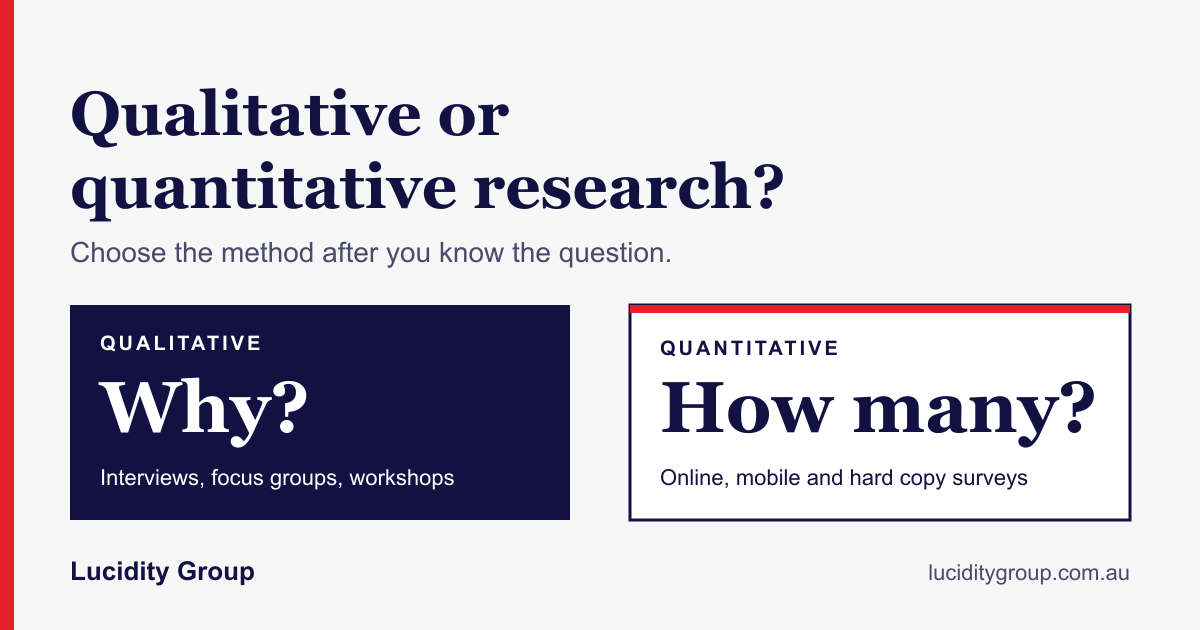
Quantitative research measures how many people think, feel or behave a certain way. It uses structured surveys and statistical analysis, and it gives you numbers you can compare, track and act on.
Qualitative research asks why. Interviews, focus groups and workshops give you reasoning, the words people actually use, and the odd thing nobody thought to ask about.
What qualitative research doesn’t give you is a number you can generalise. A dozen interviews can’t tell you what share of your customers feel a certain way, and anyone who says they can is selling you more than the method delivers.
Go qualitative when you don’t yet know the right question
If you’re testing a new concept, looking into something sensitive, or trying to understand a complicated decision, talk to people first.
One-on-one interviews suit sensitive or highly individual topics, and they’re the better choice when you want one decision-maker’s reasoning without anyone else in the room influencing it. Focus groups work differently. Put people together and you see how they react to each other, which is where shared attitudes and unspoken norms tend to show up. Workshops sit alongside both when you want to build something, a plan or a concept, with the people it affects.
Go quantitative when you need to size or track something
Some questions are about quantity. How many staff are satisfied? Which of three options people prefer. Whether anything has changed since last year. For those, you need a survey built around the people you need to hear from.
Online is the fastest and most cost-effective option for most business and consumer audiences, and it’s usually where we’d start. Usually. It isn’t always right. A resident survey in a retirement village that goes out online only can miss the very people you most need to hear from, and a hard copy survey is sometimes the better method there, not the fallback.
Retirement villages are a big part of our work. RetireAustralia’s Chief Operating Officer, Simon Fawssett, says on our testimonials page that the results of its resident survey are “vital to our core business success”. Nicole Hall, its National Manager, People & Culture, says “We have been working with Lucidity for over four years”, across both resident and employee research.
Sample size has no magic number
People often ask how many responses they need. The honest answer depends on three things: audience size, how confident you need to be in the result, and what you plan to do with it. A 60-person company and a national customer base need very different samples.
A fixed number offered before anyone has asked who you’re surveying is a guess. We settle sample size at the briefing stage, once we know the audience and the decision.
Using both, in order
The most common combination is qualitative first. Explore the issue in depth, then run a quantitative study to see how widely the findings hold.
The order isn’t fixed, though. If a survey throws up a result nobody expected, a handful of interviews afterwards will usually explain it faster than a second survey would.
A quick way to choose
If your question starts with “why” or “how”, start qualitative. If it starts with “how many” or “how much”, start quantitative. If it starts with both, you probably need both.
Most projects run from briefing through fieldwork to reporting in weeks, not months, with a senior researcher managing the work throughout.
Not sure which one your project needs? That’s a normal place to start. Tell us the decision you’re trying to make and we’ll tell you whether it’s interviews, a survey, or both. Get in touch.
